As the rainy season draws closer, a looming fertiliser crisis threatens to derail the upcoming agricultural cycle, leaving smallholder farmers grappling with soaring prices, severe supply shortages, and mounting uncertainty.
The gravity of the situation is underscored by data from the Fertiliser Association of Malawi (FAM), which reveals that current national stocks stand at approximately 148 000 metric tonnes. This falls drastically short of the estimated annual requirement of 450 000 to 475 000 metric tonnes, exposing the country to a deficit of over 300 000 metric tonnes.
For ordinary smallholders, the macroeconomic shortfall translates into immediate, crushing hardship on the ground.
In Mvunguti Village, Traditional Authority Chitukula in Lilongwe District, Jenipher Langton is frantically preparing her garden with mounting dread. After touring town shops last week, she was met with prohibitive costs and empty shelves.
“Fertiliser is unaffordable for a small-scale farmer like me. It’s hard and I hope the situation will improve. Otherwise, it will remain out of reach,” she said.
Like many other farmers, Langton had hoped to begin the season with access to the essential farm input.
However, the reality on the ground has left many farmers frustrated and uncertain about their prospects for the coming season.
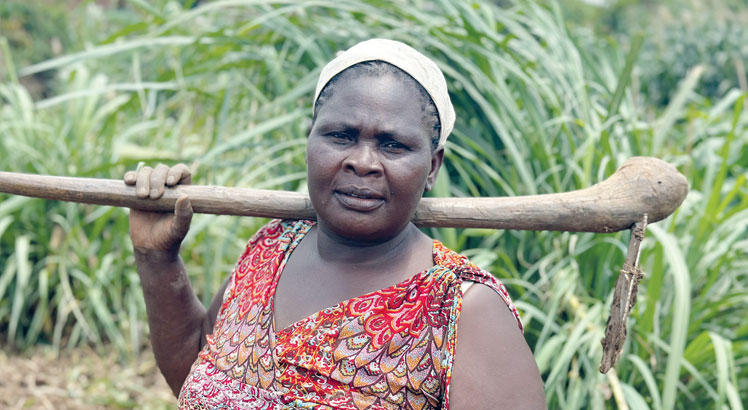
unaffordable. I Andrew
Viano
The price escalation has been punishing. A bag of urea, which traded at K150 000 in February, has surged to K210 000. Similarly, NPK fertiliser has jumped from roughly K160 000 to K220 000, with spot checks outside Lilongwe City revealing prices fast approaching K250 000 per bag.
While hope for many rests on the government’s Farm Input Subsidy Programme (Fisp), which recently rolled out to 1.2 million beneficiaries launched last month in Ntchisi District, delays in distribution are breeding widespread anxiety. Dickson Matemba of Nkhaka Village, T/A Masumbankhunda, is still waiting for instructions on how to access his subsidized allocation.
He is waiting for instruction on how to buy the subsidised fertiliser, but feared delays could affect his farming season.
“With the current prices, I don’t think I can afford it. I hope Fisp fertiliser will be made available in time,” said Matemba.
The price increases come amid concerns about the country’s fertilizer supply ahead of the rainy season.
Detailing the supply pipeline, FAM executive administrator Hannah Makhambera explained that of the 148 000 metric tonnes accounted for, only 35 068 metric tonnes are currently in the country. A further 66 940 metric tonnes sit stranded or moving through regional ports at Beira, Dar es Salaam, and Nacala, while 46 000 metric tonnes are still at sea.
Makhambera noted that procurement and importation efforts are ongoing, asserting that the private sector retains the capacity to bridge the gap through commercial imports and local blending.
However, she conceded that hurdles remain formidable: “Access to foreign exchange, procurement timelines, international market conditions, and logistics are key factors affecting the pace at which additional fertilizer reaches the country. We are engaging stakeholders on measures to support timely importation and distribution.”
Notably, current import volumes lag significantly behind last year’s pace, when roughly 200 000 metric tonnes were already at various stages of importation around the same period.
The volumes of fertiliser imported this far is far below what was imported last year around the same time when about 200 000 metric tonnes were at various stages of importation.
Responding to concerns over currency liquidity, Reserve Bank of Malawi (RBM) spokesperson Boston Maliketi Banda stated that the central bank encourages commercial banks to prioritise strategic imports within prevailing forex limits.
“It is important to note that we do not directly allocate foreign exchange to individual importers. Fertiliser importers are, therefore, encouraged to work with their commercial banks to access foreign exchange, subject to availability and applicable banking arrangements. The Bank remains supportive of efforts to facilitate fertilizer imports and will continue to work with relevant stakeholders within its mandate,” he said.
Agriculture expert Leonard Chimwaza said fertiliser shortages would affect not only the subsidy programme, but also farming in general, as fertiliser supplies play a significant role in overall agricultural production.
He said authorities should swiftly address the situation as failure to do that is recipe for poor farming season.
“Fertiliser Association of Malawi plays a critical role in ensuring the availability of fertiliser in the country. Government should find a solution to this because whatever happens here will affect farming in Malawi.
“Moving forward, preparation should be key in every farming season. We need to ensure such issues are sorted out well before the official launch of Fisp,” said Chimwaza
About 2.6 million Malawians are expected to face hunger during the 2026/27 consumption period, representing 14 percent of the country’s projected population.
The Ministry of Agriculture has estimated maize production at 3 300 618 metric tonnes in the 2025/26 agricultural season compared to 2 859 948 metric tonnes in the 2024/25 agricultural season, representing an increase of about 15 percent.